
In 2004, the largest particle physics laboratory in the world, CERN (European Organization for Nuclear Research) in Switzerland, 50 years old. In an attempt to find answers to fundamental questions of nature, physicists from around the world come from 1954, an international collaboration that requires an advanced communication technology and data exchange. They are, in total, 56 participants, between countries and international organizations.
Using a tunnel of time, physicists simulate a trip to a fraction of a second after the Big Bang, the great explosion that resulted in the universe. The so-called "tunnel" is a particle accelerator: an infrastructure capable of causing collisions between particles that make up matter and dismember it, as they were after the Big Bang. Through sensors, coupled to the accelerator equipment, researchers observe what happens after the collision of these particles, which allows to study the structure of matter.
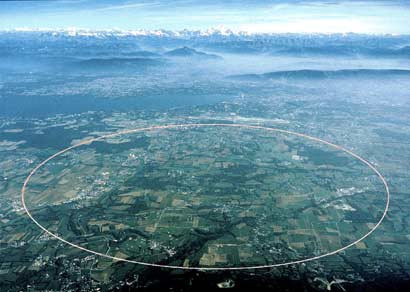
From today, has given the green light to a new accelerator, the Large Hadron Collider (LHC), which has been built in an underground tunnel 27 km in diameter. The LHC will be docked four detectors: Atlas , Compact Muon Solenoid (CMS), LHCb and A Large Ion Collider Experiment (Alice).
From LHC is expected to find the answers needed to complete the Standard Model, that is, the puzzle created by physicists to explain the origin of the universe. To do this, either way will launch a beam of protons (important because of their large mass) that will be 99.9% of the speed of light, and in this state energy, collide, reproducing with close proximity to the previous particle the Big Bang.
supercomputer is expected that it is connected to the gas collected 20 000 petabytes, or 20 million terabytes in a single year.
Observe the vastness of the huge magnet:

That's the way I see them or so. 

0 comments:
Post a Comment